Wiki
Mutex and RAII Lock
Existing English translations were reused. 4 current source blocks remain in Simplified Chinese, without triggering paid translation.
When multiple threads run simultaneously, if they access the same shared data and at least one of them modifies this data, thread synchronization must be considered.
C++ One of the most basic and most commonly used synchronization tools is:
std::mutexThe Chinese term for mutex is usually:
Mutex
Its most core function can be simply understood as:
Only one thread is allowed to enter a certain section of code that needs protection at the same time.
This section focuses on:
- 什么是共享数据、数据竞争和临界区;
std::mutex到底“锁”的是什么;lock()、try_lock()、unlock();- 为什么不推荐手动成对调用
lock()/unlock(); - RAII 为什么特别适合管理锁;
std::lock_guard的基本使用;std::unique_lock为什么更加灵活;std::scoped_lock为什么适合多把锁;- 什么是死锁,以及怎样避免;
std::recursive_mutex和std::timed_mutex;std::shared_mutex的多读单写;std::call_once的一次性初始化。
1.Why are mutexes needed?
Let's start with a classic example:
#include <print>
#include <thread>

int counter = 0;

void add_many()
{
    for (int i = 0; i < 100000; ++i)
    {
        ++counter;
    }
}

int main()
{
    std::thread t1(add_many);
    std::thread t2(add_many);

    t1.join();
    t2.join();

    std::println("{}", counter);
}
Example run result (due to data races, the actual numbers may differ each time):
104563Here, two threads are created:
线程 t1
线程 t2
Each thread executes:
++counter;100,000 times.
Intuitively:
100000 + 100000 = 200000So it seems that in the end it should definitely output:
200000However, this program has a serious concurrency problem.
The problem lies in:
++counter;1.1.++counter is not an indivisible step
We usually observe:
++counter;It feels like it is just:
counter 加 1One operation.
However, from the perspective of program execution, it usually roughly needs to go through:
读取 counter 当前值
        ↓
当前值 + 1
        ↓
把结果写回 counter
Assume now:
counter = 10Two threads executing simultaneously:
++counter;The following may occur:
线程 A:读取 counter,得到 10
线程 B:读取 counter,得到 10

线程 A:计算 10 + 1 = 11
线程 B:计算 10 + 1 = 11

线程 A:写回 11
线程 B:写回 11
Final:
counter = 11But both threads clearly performed one addition each, so the correct result should be:
counter = 12One of the modifications was lost just like that.
This indicates:
Even if C++ appears to contain only one statement in the source code, it does not mean that it is naturally immune to interference from other threads in a multithreaded environment.
1.2.What is a data race?
If:
- Multiple threads access the same memory location;
- At least one thread will write;
- There is no proper synchronization between these accesses;
the following may be produced:
Data Race
Previous:
++counter;is a typical example.
Both thread A and thread B are in:
读取 counter
修改 counter
and there are no synchronization measures.
In C++, a data race usually means:
Undefined Behavior
Therefore, it cannot be understood merely as:
"The final result is occasionally off by 1."
The real question is:
Once a data race occurs, C++ the standard no longer guarantees program behavior.
Therefore, the first very important thing in multithreaded programming is:
Do not allow multiple threads to access shared mutable data simultaneously without protection.
1.3.What is a critical section?
Assume that:
++counter;This code accesses variables shared by multiple threads:
counterAnd we hope:
Only one thread can execute it at the same time.
Then this piece of code can be called:
Critical Section
Simple understanding:
临界区
=
不能让多个线程同时执行的代码区域
For example:
++counter;It may also be a whole set of operations:
++count;
average = calculate_average();
As long as these operations must be protected as a whole, they can all belong to the same critical section.
2.std::mutex Basics
2.1.std::mutex What exactly is it
mutex is:
mutual exclusionThat is:
Mutual exclusion
You can think of it as a door lock with only one key.
Suppose there is a room:
共享数据At the door, there is:
一把 mutexThread A wants to enter:
线程 A
  ↓
尝试获得 mutex
  ↓
成功
  ↓
进入临界区
At this point, thread B also wants to enter:
线程 B
  ↓
尝试获得 mutex
  ↓
发现 mutex 已经被 A 持有
  ↓
等待
After thread A leaves:
线程 A 释放 mutexOnly then does Thread B have a chance to acquire it.
So the core effect of a mutex is:
线程 A ─┐
线程 B ─┼→ 同一时刻只能有一个线程通过
线程 C ─┘2.2.A mutex does not automatically "lock a variable".
This is a point that is very easily misunderstood when first learning about mutexes.
For example:
int counter = 0;
std::mutex mutex;
mutex does not know:
counterExistence.
There is no automatic binding relationship between it and counter.
For example, thread A:
mutex.lock();
++counter;
mutex.unlock();
But if thread B directly:
++counter;A mutex simply cannot stop it.
So a more accurate understanding is:
A mutex does not lock a particular variable; rather, it prevents all threads that follow the same locking rules from entering a certain section of code at the same time.
We artificially stipulate:
凡是访问 counter
都必须先获得 counter_mutex
Like so:
std::mutex counter_mutex;only then does it truly serve the purpose of protecting counter.
2.3.std::mutexBasic usage of
std::mutex Defined in:
#include <mutex>The three most basic operations are:
mutex.lock();
mutex.try_lock();
mutex.unlock();2.3.1.lock(): Acquire the lock (not lock, but acquire the lock)
Basic usage:
mutex.lock();If the mutex is not currently held by another thread:
mutex 空闲
    ↓
当前线程获得 mutex
    ↓
继续执行
If the mutex is already held by another thread:
线程 A 已经持有 mutex
          ↓
线程 B 调用 lock()
          ↓
暂时拿不到
          ↓
线程 B 阻塞等待
Wait for thread A:
mutex.unlock();Only then will thread B have a chance to continue.
Therefore:
lock();It can be simply remembered as:
If you can't get it, wait. (Very important)
2.3.2.unlock() : Release the lock
After the thread acquires the mutex:
mutex.lock();After completing the critical section operation, you should:
mutex.unlock();For example:
mutex.lock();

++counter;

mutex.unlock();
The execution process is roughly as follows:
获得 mutex(获得不了就阻塞,卡在这里)
    ↓
进入临界区
    ↓
修改 counter
    ↓
离开临界区
    ↓
释放 mutex
After it is released, other threads waiting on this mutex have a chance to continue execution.
2.3.3.try_lock():If you can't get it, then forget it.
Sometimes, we do not want to:
拿不到锁
↓
一直等(阻塞)
Instead, the hope is:
拿得到就执行
拿不到就先干别的(不想阻塞卡在这里)
In this case, you can use:
try_lock()For example:
if (mutex.try_lock())
{
    ++counter;

    mutex.unlock();
}
else
{
    // 这一次没有获得 mutex
}
The difference can be simply remembered as:
lock()

拿不到
↓
等待(阻塞)
And:
try_lock()

拿不到
↓
立即返回 false(不会阻塞)
On success:
trueOn failure:
falseTherefore:
if (mutex.try_lock())
{
    // 当前线程已经获得锁
}
Note that the standard permits try_lock() sporadic failures.
So do not put:
try_lock() == falseAbsolutely understood as:
There must now be another thread holding the mutex.
A simpler way to understand it is:
This time the lock was not acquired.
2.4.Fix with mutex counter
The previous data race can be resolved as follows:
#include <print>
#include <mutex>
#include <thread>

int counter = 0;
std::mutex counter_mutex;

void add_many()
{
    for (int i = 0; i < 100000; ++i)
    {
        counter_mutex.lock();

        ++counter;

        counter_mutex.unlock();
    }
}

int main()
{
    std::thread t1(add_many);
    std::thread t2(add_many);

    t1.join();
    t2.join();

    std::println("{}", counter);
}
Operation result:
200000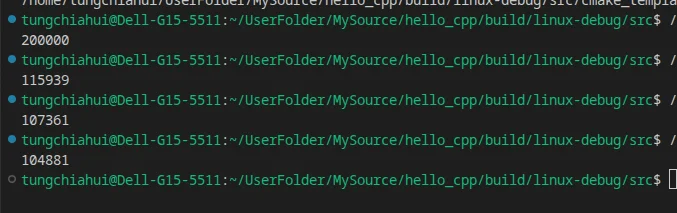
As shown above, only the first one with a mutex mechanism outputs correctly200000; the outputs of the others without a mutex mechanism are non-deterministic.
All parties now wanting to modify:
counterthread must first:
counter_mutex.lock();Thus it may occur:
线程 A 获得 counter_mutex
        ↓
    ++counter
        ↓
线程 A 释放 counter_mutex
        ↓
线程 B 获得 counter_mutex
        ↓
    ++counter
without two threads modifying it at the same time.
However, this approach still has a major problem:
lock();
...
unlock();
Fully managed by the programmers themselves.
2.5.Why is it not recommended to handwrite lock() / unlock()
The following code looks fine:
mutex.lock();

change_shared_state();

mutex.unlock();
But in the future, the code might become:
mutex.lock();

if (something_wrong())
{
    return;
}

change_shared_state();

mutex.unlock();
If:
something_wrong()true:
return;it will directly exit the function.
Therefore:
mutex.unlock();will never be executed.
The mutex will remain locked.
If other threads again:
mutex.lock();it may just stay stuck there.
There are also exceptions:
mutex.lock();

some_function();

mutex.unlock();
If:
some_function();Throw an exception; the following:
mutex.unlock();It will likewise not execute normally.
Therefore manually manage:
lock()
unlock()
The biggest problem is:
It must be ensured that every exit path of the program correctly releases the lock.
Once the code becomes complex, it is very easy to overlook things.
This is very similar to the problem faced in memory management bynewanddelete, and in memory management, we use the RAII approach to solve this problem, that is, smart pointers.
This is exactly the kind of problem that RAII is particularly well suited to solve.
3.RAII lock management
3.1.Why RAII is suitable for managing locks
The core idea of RAII has been learned before:
Let the resource lifecycle be managed by the object lifecycle.
Ownership of a mutex can also be viewed as a kind of resource.
Therefore, we hope to have such an object:
对象构造
↓
mutex.lock()

对象析构
↓
mutex.unlock()
This way, only the following is needed:
{
    某个 RAII 锁对象 lock(mutex);

    // 临界区
}
When the scope ends:
}
↓
lock 对象自动析构
↓
自动释放 mutex
there is no need for programmers to write it everywhere themselves:
unlock();This is:
RAII lock
3.2.std::lock_guard
One of the simplest and most commonly used RAII locks is:
std::lock_guardFor example:
std::mutex mutex;

void foo()
{
    std::lock_guard<std::mutex> lock(mutex);

    // 临界区
}
Execute:
std::lock_guard<std::mutex> lock(mutex);it can be simply understood as:
lock_guard 构造
        ↓
mutex.lock()
When leaving the scope:
lock_guard 析构
        ↓
mutex.unlock()
Therefore:
void foo()
{
    std::lock_guard<std::mutex> lock(mutex);

    change_shared_state();

} // 自动释放 mutex
No need to write:
mutex.unlock();3.3.Rewrite the counter using lock_guard.
The previous code can be written as:
#include <print>
#include <mutex>
#include <thread>

int counter = 0;
std::mutex counter_mutex;

void add_many()
{
    for (int i = 0; i < 100000; ++i)
    {
        std::lock_guard<std::mutex> lock(counter_mutex);

        ++counter;
    }
}

int main()
{
    std::thread t1(add_many);
    std::thread t2(add_many);

    t1.join();
    t2.join();

    std::println("{}", counter);
}
Operation result:
200000Each cycle:
创建 lock_guard
      ↓
获得 counter_mutex
      ↓
++counter
      ↓
这一轮作用域结束
      ↓
lock_guard 析构
      ↓
自动释放 mutex
In this way, even if the following appears in the code later:
return;Or with normal exception stack unwinding, it is also less easy to forget to release the lock.
C++17 Initially, it can also be written using class template argument deduction as:
std::lock_guard lock(counter_mutex);Not necessarily required to write:
std::lock_guard<std::mutex>3.4.You can use {} to actively reduce the scope of the lock
When is the RAII lock released?
The answer is:
When the lock object is destructed, the mutex is released.
So we can use {} to create a local scope:
void foo()
{
    do_something();

    {
        std::lock_guard lock(mutex);

        change_shared_state();
    }

    do_other_work();
}
Execution logic:
do_something()

获得 mutex
↓
修改共享数据
↓
释放 mutex

do_other_work()
Like so:
do_other_work();it will not continue to hold the mutex.
3.5.The critical section should be as small as possible.
Assume it is written as:
std::lock_guard lock(mutex);

do_big_calculation();
save_file();
send_network_data();

update_shared_state();
Then throughout the entire process:
mutex 一直被当前线程持有Other threads that need this mutex can only:
等待However:
do_big_calculation();
save_file();
send_network_data();
It may not be necessary to access shared data at all.
A more reasonable approach is usually:
do_big_calculation();
save_file();
send_network_data();

{
    std::lock_guard lock(mutex);

    update_shared_state();
}
Therefore, typically:
Place only the operations that truly require mutual exclusion protection into the critical section.
Be especially cautious about performing the following while holding a lock:
- 长时间计算;
sleep;- 文件 IO;
- 网络 IO;
- 等待其他线程;
- 执行耗时未知的函数。
Otherwise, other threads will be unable to acquire the lock for a long time.
3.6.But critical sections also cannot be split arbitrarily.
"Keep the critical section as small as possible" does not mean:
Each line of code is locked separately once.
Assume that:
int count;
double average;
And these two values must always maintain a corresponding relationship.
For example:
++count;
average = calculate_average();
Then these two operations should probably belong to the same critical section:
std::lock_guard lock(state_mutex);

++count;
average = calculate_average();
If split into:
{
    std::lock_guard lock(state_mutex);
    ++count;
}

{
    std::lock_guard lock(state_mutex);
    average = calculate_average();
}
Between the two locks, another thread may interleave and read:
新的 count
+
旧的 average
Thus, a logically inconsistent state is observed.
Therefore:
The critical section should be as small as possible, but it must ensure that a complete modification of shared state is not split apart.
3.7.Locks protect "shared state"
Assumption:
struct User
{
    std::string name;
    int age;
};
If:
name
age
Together they form a complete user state, so it is more reasonable that:
std::mutex user_mutex;
User user;
Then:
void update_user()
{
    std::lock_guard lock(user_mutex);

    user.name = "Tom";
    user.age = 20;
}
rather than:
name 一把锁
age 一把锁
So when designing a mutex, do not only think:
Which line of code should be locked?
More importantly, consider:
Which data collectively form a shared state that must remain consistent?
3.8.Reducing shared data is usually better than going crazy with locking.
Look at this example:
for (int i = 0; i < 100000; ++i)
{
    std::lock_guard lock(counter_mutex);
    ++counter;
}
Although it is correct, it will repeat:
lock
unlock
lock
unlock
lock
unlock
...
Consider changing it to:
void add_many()
{
    int local_counter = 0;

    for (int i = 0; i < 100000; ++i)
    {
        ++local_counter;
    }

    std::lock_guard lock(counter_mutex);

    counter += local_counter;
}
Here:
local_counterIt is used only by the current thread, so no lock is needed.
The entire thread first completes on its own:
100000 次本地计算Finally:
加一次锁
↓
更新共享 counter
This reflects an important idea in concurrent programming:
If data can be not shared, then try not to share it.
Because:
没有共享
↓
通常也就不需要同步4.std::unique_lock (common)
lock_guardThe characteristic is very simple:
创建
↓
加锁

销毁
↓
解锁
But sometimes we want more flexibility.
For example:
先获得锁
↓
读取共享数据
↓
提前释放锁
↓
继续执行耗时操作
In this case, you can use:
std::unique_lockThe simplest way to write it:
std::unique_lock<std::mutex> lock(mutex);Same as lock_guard :
构造时获得 mutex
析构时自动释放 mutex
However, unique_lock provides more control capabilities.
4.1.unique_lock Can be unlocked in advance
For example:
std::unique_lock lock(mutex);

read_shared_state();

lock.unlock();

do_expensive_work();
Execution logic:
获得 mutex
↓
访问共享数据
↓
主动释放 mutex
↓
执行耗时操作
However, lock_guard does not provide this manual unlocking capability.
4.2.unique_lock It can be locked again
For example:
std::unique_lock lock(mutex);

read_shared_state();

lock.unlock();

do_something();

lock.lock();

change_shared_state();
Therefore, unique_lock can perform:
lock
↓
unlock
↓
lock
↓
unlock
However, the more complex this code is, the more prone the lock design is to problems.
Therefore, use this only when such flexibility is truly needed.
4.3.Deferred locking:std::defer_lock
Default:
std::unique_lock lock(mutex);The mutex is acquired immediately.
But it can be written as:
std::unique_lock lock(mutex, std::defer_lock);At this point:
unique_lock 对象已经创建
但是 mutex 还没有被锁住
Afterward:
lock.lock();For example:
std::unique_lock lock(mutex, std::defer_lock);

do_something();

lock.lock();

change_shared_state();4.4.Attempt to lock: std::try_to_lock
Also available:
std::unique_lock lock(mutex, std::try_to_lock);It attempts to acquire the mutex, but does not wait indefinitely if the lock is temporarily unavailable.
Afterward, you can:
if (lock.owns_lock())
{
    // 已经获得 mutex
}
else
{
    // 当前没有获得 mutex
}4.5.owns_lock()
Since unique_lock is relatively flexible, so one:
unique_lockAn object does not necessarily always hold the mutex.
For example:
std::unique_lock lock(mutex, std::defer_lock);When newly created:
lock.owns_lock()As:
falseExecute:
lock.lock();Later:
lock.owns_lock()It is only:
trueIf again:
lock.unlock();It will change back to:
false4.6.lock_guard and unique_lock how to choose
At the beginner stage, you can directly remember:
| Tool | Feature | Common scenario |
|---|---|---|
std::lock_guard |
Simple, the entire scope always holds the lock | Ordinary critical section |
std::unique_lock |
Can actively unlock, relock, delay locking, try locking | Need flexible management of the lock lifecycle |
So usually:
普通情况
↓
lock_guard
Requires:
unlock()
重新 lock()
defer_lock
try_to_lock
and other capabilities:
unique_lockDo not assume that because unique_lock has more features:
It is always better than
lock_guard.
More features also mean more complex state.
When a simple solution is available, the simple solution is generally preferred.
| 项目 | lock_guard |
unique_lock |
|---|---|---|
| 自动加锁/解锁 | ✅ | ✅ |
手动 unlock() / lock() |
❌ | ✅ |
| 延迟加锁 | ❌ | ✅ |
try_lock |
❌ | ✅ |
| move | ❌ | ✅ |
condition_variable |
❌ | ✅ |
| 对象大小 | 更小 | 通常更大 |
| 理论运行开销 | 最低 | 略高 |
| 灵活性 | 低 | 高 |
In terms of efficiency alone, std::lock_guard is slightly higher than std::unique_lock, but the difference is usually so small that it can basically be ignored.
5.Deadlocks and Multiple Locks
5.1.What is a deadlock?
A mutex can solve the problem of many threads accessing shared data simultaneously.
However, if multiple mutexes are used simultaneously, new problems may arise:
Deadlock, of course, is not the game developed by Valvedeadlock.
Assumption:
std::mutex m1;
std::mutex m2;
Thread A:
void task1()
{
    std::lock_guard lock1(m1);
    std::lock_guard lock2(m2);
}
Thread B:
void task2()
{
    std::lock_guard lock2(m2);
    std::lock_guard lock1(m1);
}
The lock order of the two threads is different:
线程 A:
m1 → m2

线程 B:
m2 → m1
Thus it may happen:
线程 A 获得 m1

线程 B 获得 m2

线程 A 想获得 m2
但是 m2 在线程 B 手里
↓
A 等待 B

线程 B 想获得 m1
但是 m1 在线程 A 手里
↓
B 等待 A
Final:
A 等 B
B 等 A
No one could continue.
This is:
Deadlock
5.2.An intuitive example of deadlock
You can think of two mutexes as two chopsticks.
Two people eating must simultaneously have:
左筷子
+
右筷子
A got the left chopstick.
B got the right chopstick.
Then:
A:等 B 放下右筷子

B:等 A 放下左筷子
But neither of the two was willing to be the first to put down the chopsticks they had already picked up.
Therefore:
谁也吃不上饭This is very similar to thread deadlock.
5.3.Avoid deadlocks: fixed lock ordering
A very important method is:
The entire program enforces a unified lock acquisition order.
For example, it is stipulated:
永远先获得 m1
再获得 m2
Then all threads must:
std::lock_guard lock1(m1);
std::lock_guard lock2(m2);
rather than writing in some places:
m1 → m2Yet in other places it is written:
m2 → m1A unified lock ordering can avoid many typical deadlocks.
5.4.std::scoped_lock
If an operation originally requires:
Acquire multiple mutexes simultaneously
C++17 Provided by:
std::scoped_lockFor example:
#include <mutex>

std::mutex m1;
std::mutex m2;

void task()
{
    std::scoped_lock lock(m1, m2);

    // 当前同时持有 m1 和 m2
}
It acquires these locks using the deadlock avoidance strategy provided by the standard library.
Compared to:
std::lock_guard lock1(m1);
std::lock_guard lock2(m2);
If your intention was originally:
我要一起拿到 m1 和 m2Then:
std::scoped_lock lock(m1, m2);usually more direct.
After the scope ends:
scoped_lock 析构
↓
自动释放它管理的锁5.4.1.scoped_lock You can also manage a single lock
It does not necessarily have to pass more than two mutexes.
Alternatively:
std::scoped_lock lock(mutex);For an ordinary scenario with a lock, it and:
std::lock_guard lock(mutex);Very close.
At the beginner stage, you can simply remember:
普通单锁
→ lock_guard

需要灵活控制
→ unique_lock

同时管理多把锁
→ scoped_lock5.5.std::lock()
C++11 also provides:
std::lock(m1, m2);It can use a deadlock avoidance algorithm to attempt to acquire multiple lockable objects.
For example:
std::lock(m1, m2);After successful execution:
m1 已经被当前线程获得
m2 也已经被当前线程获得
Next, they usually need to be handed over to an RAII object for management.
For example:
std::lock(m1, m2);

std::lock_guard lock1(m1, std::adopt_lock);
std::lock_guard lock2(m2, std::adopt_lock);
Here:
std::adopt_lockIt can be understood as telling lock_guard:
I have already locked this mutex in advance, so you should not call
lock()again; just take it over from now on and be responsible for releasing it at the end.
Therefore:
std::adopt_lockThe premise is:
The current thread must already hold this lock.
C++17 Later, if it is only:
同时获得多把 mutex
+
自动管理它们的生命周期
Usually:
std::scoped_lock lock(m1, m2);Even simpler.
| Lock | Single mutex performance | Flexibility | Multiple mutexes |
|---|---|---|---|
lock_guard |
⭐⭐⭐⭐⭐ | Low | Inconvenient |
scoped_lock |
⭐⭐⭐⭐⭐ | Low | Best |
unique_lock |
⭐⭐⭐⭐≈ | Highest | Can be combined with std::lock |
6.Other mutex types
6.1.std::recursive_mutex
Normal:
std::mutexIt is not appropriate for the same thread to repeatedly acquire the same mutex.
For example:
void A()
{
    std::lock_guard lock(mutex);

    B();
}

void B()
{
    std::lock_guard lock(mutex);
}
Call:
A()
↓
已经获得 mutex
↓
A() 调用 B()
↓
B() 又尝试获得同一把 mutex
This will cause problems.
If the program indeed requires:
The same thread repeatedly enters a region protected by the same lock
Can be used:
std::recursive_mutexFor example:
std::recursive_mutex mutex;It allows the same thread to repeatedly acquire this lock.
However:
recursive_mutexshould normally not be the first choice.
If the code relies heavily on recursive locks, it sometimes indicates:
函数职责
或
锁的边界
Designed to be overly complex.
When recursion-induced locking can be avoided by reorganizing the code structure, it is usually easier to maintain.
6.2.std::timed_mutex
Normal:
mutex.lock();It can be understood as:
If it cannot be obtained for the time being, then keep waiting.
However, sometimes a program does not want to wait indefinitely.
For example:
最多等 100msIn this case, you can use:
std::timed_mutexIt supports:
try_lock_for()
try_lock_until()
For example:
#include <chrono>
#include <mutex>

std::timed_mutex mutex;

if (mutex.try_lock_for(std::chrono::milliseconds(100)))
{
    // 成功获得 mutex

    mutex.unlock();
}
else
{
    // 在等待时间内没有获得 mutex
}
Among them:
try_lock_for()Emphasis:
Maximum waiting time.
For example:
100ms
2s
And:
try_lock_until()Emphasis:
Wait until which point in time.
They and those learned previously:
sleep_for()
sleep_until()
The approach is relatively similar in terms of "relative time / absolute time".
6.3.std::shared_mutex: Multiple read, single write
A regular mutex has one characteristic:
Whether you are reading data or writing data, only one thread can hold the lock at any given time.
Suppose the program contains:
std::string config;Many threads are simply:
读取 configThere are very few cases where it is actually modified.
If a normal mutex is used:
线程 A 读
↓
线程 B 即使也只是读
也必须等待
However:
读 + 读Usually, they do not corrupt each other's data.
What is truly dangerous is:
读 + 写Or:
写 + 写So C++17 provides:
std::shared_mutexIt can support:
Multiple reader threads can enter simultaneously, but a writer thread must have exclusive access.
6.3.1.shared_lock and unique_lock
When using shared_mutex:
Reading typically uses:
std::shared_lockWriting typically uses:
std::unique_lockFor example:
#include <mutex>
#include <shared_mutex>
#include <string>

std::string config;
std::shared_mutex config_mutex;

std::string read_config()
{
    std::shared_lock lock(config_mutex);

    return config;
}

void write_config(std::string value)
{
    std::unique_lock lock(config_mutex);

    config = std::move(value);
}
Multiple threads all read:
线程 A:shared_lock
线程 B:shared_lock
线程 C:shared_lock
They can exist simultaneously.
But the writer thread:
std::unique_lock lock(config_mutex);Must be exclusive.
It can be simply remembered as:
shared_lock + shared_lock
✓ 可以同时存在

shared_lock + unique_lock
✗ 不可以

unique_lock + unique_lock
✗ 不可以
This is:
Multiple readers, single writer.
6.3.2.Why might reads also require locking?
There is a very common incorrect way of writing:
void write()
{
    std::lock_guard lock(mutex);

    value = 10;
}

int read()
{
    return value;
}
Some might think:
It is enough to lock when writing; reading will not modify the variable.
Actually, that is not the case.
If:
线程 A 正在写 valueSimultaneously:
线程 B 正在读 valuedata races may still occur.
Therefore:
If there is concurrent writing to shared data, the corresponding reads usually must also participate in the same synchronization rules.
Cannot only lock writes without considering reads.
6.3.3.shared_mutex Not necessarily faster than an ordinary mutex
See:
多个线程可以同时读It is easy to produce a misunderstanding:
Then wouldn't it be better to just use shared_mutex for everything from now on?
Actually, shared_mutex more complex state needs to be maintained by oneself, for example:
现在有几个读线程?
有没有写线程?
什么时候允许写线程进入?
These themselves all have additional overhead.
Therefore:
std::shared_mutexMore suitable:
读很多
写很少
并且确实存在大量并发读取
scenarios.
Do not simply assume:
shared_mutex 一定比 mutex 快They simply apply to different scenarios.
7.One-time initialization
7.1.std::call_once
There is also a special type of multithreading requirement:
A certain piece of initialization code can only be executed successfully once.
For example:
initialize();There may be three threads entering simultaneously for the first time:
线程 A
线程 B
线程 C
But we hope:
initialize()In the end, it was successfully completed only once.
The standard library provides:
std::once_flag
std::call_once
For example:
#include <print>
#include <mutex>
#include <thread>

std::once_flag flag;

void initialize()
{
    std::println("initialize once");
}

void worker()
{
    std::call_once(flag, initialize);
}

int main()
{
    std::thread t1(worker);
    std::thread t2(worker);
    std::thread t3(worker);

    t1.join();
    t2.join();
    t3.join();
}
Operation result:
initialize onceAll three threads will execute:
std::call_once(flag, initialize);However:
initialize();只会成功完成一次。
It can be roughly understood as:
线程 A ─┐
线程 B ─┼→ call_once → initialize 成功一次
线程 C ─┘
If an exception is thrown during the execution of the initialization function, this time will not be considered successfully completed, and subsequent calls can still attempt again.
7.2.Function-local static initialization is also thread-safe
C++11 Start:
MyObject& instance()
{
    static MyObject object;

    return object;
}
Here:
static MyObject object;The initialization itself already has a thread-safety guarantee.
So if the purpose is only:
Lazily initialize a static object inside a function
Usually, there is no need to additionally write:
std::call_once8.Engineering Practice (Important)
8.1.It is best to encapsulate the mutex together with the data it protects
Not recommended to design as:
函数 A:
调用前必须先锁 mutex

函数 B:
自己内部会锁

函数 C:
只能在已经持锁时调用

函数 D:
有时候锁,有时候不锁
Once there is a lot of code, it easily turns into:
Who exactly is responsible for locking?
A better design is usually:
Let classes that own shared data manage synchronization themselves.
For example:
class Counter
{
public:
    void increment()
    {
        std::lock_guard lock(mutex_);

        ++value_;
    }

    int get() const
    {
        std::lock_guard lock(mutex_);

        return value_;
    }

private:
    mutable std::mutex mutex_;
    int value_ = 0;
};
Externally, only the following is needed:
counter.increment();There is no need to know:
内部用了哪把 mutex
什么时候 lock
什么时候 unlock
This makes the synchronization rules more centralized and also makes it less likely to miss a lock.
8.2.Why is mutex often written as mutable (Important)
Previous:
int get() constis a const member function.
However, for mutex:
mutex_.lock();
mutex_.unlock();
will modify the mutex's own internal state.
So usually write:
mutable std::mutex mutex_;Thus, even if the current member function is:
constIt is still possible to lock the mutex.
This does not mean:
get()The externally observable logical state of the Counter is actually modified.
It only modifies the internal synchronization state.
So the mutex is written as:
mutableis a very common practice.
8.3.Do not casually call unknown code while holding a lock
For example:
std::lock_guard lock(mutex);

some_callback();
If:
some_callback();Internally, it also attempts to obtain:
mutexOr if other mutexes are acquired as well, very complex lock dependency relationships may result.
Therefore, a very practical principle is:
While holding a lock, try not to call external code whose locking behavior is unknown.
In particular:
回调函数
虚函数
第三方复杂函数
用户传入函数
All should be cautious.
8.4.How to remember the three commonly used RAII locks
At the beginner stage, it can be remembered as:
std::lock_guard
│
├─ 简单
├─ 构造时加锁
├─ 析构时解锁
└─ 普通单锁场景优先考虑
std::unique_lock
│
├─ 更灵活
├─ 可以 unlock()
├─ 可以重新 lock()
├─ 支持 defer_lock
└─ 支持 try_to_lockstd::scoped_lock
│
├─ C++17
├─ RAII
├─ 可以管理一把锁
└─ 特别适合同时管理多把锁The simplest way to remember:
普通单锁
→ lock_guard

灵活控制
→ unique_lock

同时多锁
→ scoped_lock9.Common Errors
9.1.Lock only write operations
void write()
{
    std::lock_guard lock(mutex);

    value = 10;
}

int read()
{
    return value;
}
If there are concurrent writes, unsynchronized reads can likewise produce a data race.
9.2.Manually lock() forgot after unlock()
For example:
mutex.lock();

if (error)
{
    return;
}

mutex.unlock();
Therefore, in ordinary scenarios, RAII locks are preferred.
9.3.Inconsistent order of multiple locks
线程 A:
m1 → m2

线程 B:
m2 → m1
may cause deadlock.
9.4.The critical section is too large
For example:
std::lock_guard lock(mutex);

sleep();
network_io();
file_io();
big_calculation();
Other threads may be unable to acquire the mutex for a long time.
9.5.Critical section too small
The data that should have been updated as a whole was split apart:
锁
修改 A
解锁

锁
修改 B
解锁
may cause other threads to see an inconsistent state in between.
9.6.Calling an unknown function while holding a lock
std::lock_guard lock(mutex);

callback();
If the callback internally involves locks, it may cause deadlocks or complex lock dependencies.
9.7.Adding locks everywhere for the sake of “safety”
More locks do not necessarily mean greater security.
More locks may bring about:
更复杂的锁关系
↓
更多线程竞争
↓
更差的性能
↓
更高的死锁风险
What should really be done is:
Specify which shared state is protected by which mutex.
9.8.Assuming that a mutex automatically protects variables
Below:
std::mutex mutex;
int counter;
will not be established automatically:
mutex 保护 counterrelationship.
All threads must comply with:
访问 counter 前
必须按照约定获得 mutex
mutex really takes effect.
9.9.think shared_mutex is necessarily faster
shared_mutex It allows multiple threads to read simultaneously, but the management cost is also higher.
Only truly:
读很多
写很少
存在明显并发读取需求
only then is it worth considering.
10.The Most Important Mutex Mental Model
See:
std::mutex mutex;Do not simply understand it as:
Created a lock that can lock variables.
A better understanding is:
Created a synchronization object in which multiple threads compete for the qualification to enter a certain critical section.
See:
std::lock_guard lock(mutex);It can be understood as:
线程想进入临界区
        ↓
先获得 mutex
        ↓
获得成功
        ↓
进入临界区
        ↓
离开作用域
        ↓
自动释放 mutex
Other threads:
暂时拿不到 mutex
↓
不能同时进入
This is the most core idea of a mutex.
11.Summary
std::mutexThe most core function is:
Allow multiple threads to mutually exclusive access shared mutable state.
The three most basic operations:
lock()
try_lock()
unlock()
However, in actual development, manual writing is not recommended for ordinary scenarios:
mutex.lock();

...

mutex.unlock();
Instead, RAII objects should be given priority to manage locks.
Ordinary single-lock scenario:
std::lock_guardNeed more flexible control over lock lifecycle:
std::unique_lockNeed to manage multiple locks simultaneously:
std::scoped_lockRequires multiple reads and single writes:
std::shared_mutexNeed to wait with a timeout:
std::timed_mutexIndeed, this is needed when the same thread must repeatedly enter the same critical section:
std::recursive_mutexIt is necessary to make a certain piece of initialization logic execute successfully only once:
std::call_onceWhat truly needs to be considered in concurrent code is usually not:
mutex API 怎么写?Instead:
哪些数据会被多个线程共享?
哪些操作必须作为一个整体?
哪把 mutex 负责保护这些状态?
临界区应该有多大?
有没有同时获取多把锁?
不同地方的锁顺序是否一致?
Once these issues are thought through, the mutex's own code is usually not complex.
For the synchronization of a "single simple shared variable" and the two types of problems of "making a thread wait for a certain condition to occur", the later std::atomic and std::condition_variable chapters will continue to introduce them respectively.